| THE PROBLEMS OF STREET CHILDREN |
| Many of the street children who have run away from home have done so because they were beaten or sexually abused. Tragically, their homelessness can lead to further abuse through exploitative child labour and prostitution. Not
only does abuse rob runaway children of their material security, but
it also leaves them emotionally scarred. Many of the abused children
I-India encounters are traumatised and some refuse to speak for months.
To aggravate matters, children often feel guilty and blame themselves
for their mistreatment. Such damage can take years to recover from
in even the most loving of environments; on the streets it may never
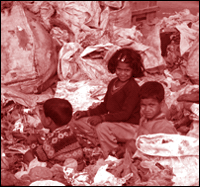
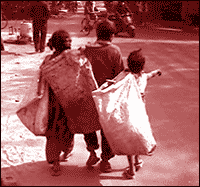
heal. Most Indian street children work. In Jaipur, a common job is rag-picking, in which boys and girls as young as 6 years old sift through garbage in order to collect recyclable material. The children usually rise before dawn and carry their heavy load in a large bag over their shoulder. Rag-pickers can be seen alongside pigs and dogs searching through trash heaps on their hands and knees. Other common jobs are the collecting of firewood, tending to animals, street vending, dyeing, begging, prostitution and domestic labour. Children
that work are not only subject to the strains and hazards of their
labour, but are also denied the education or training that could enable
them to escape the poverty trap. In Indian Society females are often discriminated against. Their health, education, prosperity and freedom are all impacted. The problem is worse in conservative Rajasthan than almost anywhere else in India. For example, because girls carry the liability of dowry and leave the family home after marriage, parents may prefer to have male offspring. Many babies are aborted, abandoned or deliberately neglected and underfed simply because they are girls. This can be seen in the fact that female mortality rates amongst 0-4 year olds in India are 107% of male mortality rates, whereas the comparable number in Western Europe is 74%. The rate is 119% in Rajasthan. Further evidence of the imbalance is that the female/male ratio within the general population of India is unnaturally low at 927/1000, and even lower in Rajasthan at 909/1000. Gender discrimination is particularly evident in education where boys are more likely to attend school and to do so for more years. The traditional place of the woman is in the home and so many parents and children consider education for girls to be a waste of time, especially when the child can instead be working or performing domestic chores. Only 38% of Indian women are literate and, at 64%, the gender parity between literacy rates amongst Indian women and men is one of the most unequal in the world. Child
Marriage is another way in which girls are disadvantaged. In addition
to limiting educational possibilities and stunting personal development,
early marriage carries health risks. A girl under 15 is five times
more likely to die during pregnancy than a women in her twenties;
her child is also more likely to die. Poor health is a chronic problem for street children. Half of all children in India are malnourished, but for street children the proportion is much higher. These children are not only underweight, but their growth has often been stunted; for example, it is very common to mistake a 12 year old for an 8 year old. Street
children live and work amidst trash, animals and open sewers. Not
only are they exposed and susceptible to disease, they are also unlikely
to be vaccinated or receive medical treatment. Only two in three Indian
children have been vaccinated against TB, Diphtheria, Tetanus, Polio
and Measles; only one in ten against Hepatitis B. Most street children
have not been vaccinated at all. They usually can not afford, and
do not trust, doctors or medicines. If they receive any treatment
at all it will often be harmful, as with kids whose parents place
scalding metal on their bellies as a remedy for persistent stomach
pain. There is much ignorance about reproductive health and many girls suffer needlessly. A girl made infertile by an easily-preventable condition may become unmarryable and so doomed to a life of even greater insecurity and material hardship. The
HIV/AIDS rate amongst Indian adults is 0.7% and so has not yet reached
the epidemic rates experienced in Southern Africa. However, this still
represents 5 million people, or about 1 in 7 in of those in the world
who have the disease. The rate amongst children is lower, but because
street children are far more sexually active than their Indian peers
and because many are even prostitutes they are thus hugely at risk
of contracting the disease. AIDS awareness, testing and treatment
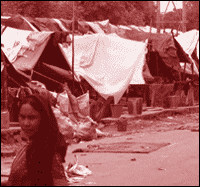
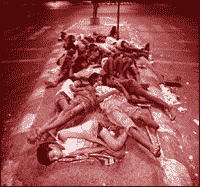
exist, but less so for street children than other demographic groups. Street children in India may be homeless because their family is homeless through poverty or migration, or because they have been abandoned, orphaned or have run away. It is not unusual to see whole families living on the sidewalks of Jaipur, or rows of individual children sleeping around the railway station. Homeless
children have the odds stacked against them. They are exposed to the
elements, have an uncertain supply of food, are likely miss out on
education and medical treatment, and are at high risk of suffering
addiction, abuse and illness. A single child alone on the streets
is especially vulnerable. Poverty is the prime cause of the street children crisis. Children from well-off families do not need to work, or beg. They live in houses, eat well, go to school, and are likely to be healthy and emotionally secure. Poverty
dumps a crowd of problems onto a child. Not only do these problems
cause suffering, but they also conspire to keep the child poor throughout
his/her life. In order to survive, a poor child in India will probably
be forced to sacrifice education and training; without skills the
child will, as an adult, remain at the bottom of the economic heap. |
Home • Street children Crisis • Examples • Contact • Ladli |